First Friday Book Review—Word by Word: a daily spiritual practice


books stack old antique
Photo by Pixabay on Pexels.com

Title: Word by Word: a daily spiritual practice

Author: Marilyn McEntyre

Publisher: Wm. B. Eerdmans Publishing Co.


“But I don’t wanna do it that way…”

Reading this excellent book takes an extreme amount of discipline—it did for me, anyway. It is set up as a daily devotional, yet I wanted to power right through it as fast as I could. 

Instead, I followed the intent of the author by reading a section each day, on the day it was meant to be read. Exercising the discipline, I gained more from the words printed on the page and those etched in my soul.

The Author’s intent

Marilyn McEntyre invites the reader to dwell on 20 words—20 verbs, to be exact—over 20 weeks. She welcomes us into the discipline by asking the reader to immerse themselves in a reflection on the same word each day for seven days in a row beginning with Sunday. 

Each day consists of just a handful of paragraphs where McEntyre challenges the reader to look at the verb in a way unlike any other view taken before. 

WOW!

She says, “The practice of living with a single word for a week can become a compliment…” to other spiritual disciplines. 

abstract board game bundle business
Photo by Pixabay on Pexels.com


Later in the introduction, she describes the delight she has had in discovering “…how words may become little fountains of grace. How a single word may become, for a time, “equipment for living.” How a single word may open wide wakes of meaning and feeling. How a single word may, if you hold it for a while, become a prayer.”


brown wooden frame sing board close up photography
Photo by Mati Mango on Pexels.com

Are you listening?

The first word  McEntyre offers is “Listen.” I’m a good listener. I used to tell my staff I heard everything, even their most faint whisper. Real as that might be, I became a better listener as I pondered the reflections about “listening” each day for one week.

“Listen…

    …for the guidance you need.

    …for the need behind the words

    …into the silences

    …as an act of participation

    …through the noise of the music

    …courageously

    …when you pray”

Hearing is not listening. It is a step in the right direction, but it is not the finish line. I learned more about listening in one week of meditations than I had in hours and days and weeks of management training on the job.

woman holding a bitcoin
Photo by Moose Photos on Pexels.com


One coin; two sides

There are 19 more words. Some of them seem like different sides of the same coin—words like “Resist” and “Allow.” Or words like “Be Still” and “Rejoice.”

 

background conceptual contemporary creativity
Photo by Public Domain Pictures on Pexels.com


How will reading this book help you? Taking time to reflect on the word, the grace of the word according to prompts from the author, you will personalize how the word, the verb, the action word, can impact the actions of your life and the lives of those closest to you.

 

color color paper colored paper colorful
Photo by Pixabay on Pexels.com


Well-read

My copy of the book is marked-up, dog-eared, Post-It noted, and highlighted beyond recognition. When I am writing something of my own—an essay, a chapter, a recollection, or a sermon, I can use Word by Word: a daily spiritual practice, to bring me back to things I learned over those worthwhile 20 weeks.

You will enjoy including Word by Word: a daily spiritual practice, by Marilyn McEntyre, in your daily moments of reading and reflection.

 

Carnival Rides, True Love, and the Moon

orange carrots on table
Photo by mali maeder on Pexels.com

Country Fair Days!

Every year in July, my hometown held a summer carnival called “Country Fair Days.” It had everything you would expect at a country fair: brats, burgers, corn on the cob, and cotton candy.

Vendors sold home-grown vegetables—long before The Farmers Market became a “thing.” Crafts, household gadgets, and jewelry were all on display. There was a midway with carnival rides for all ages. My grandfather sold vegetables there. From the time I was a little boy till the year he died, I helped him in his booth.

Live bands performed throughout the day. In the evening the headliners played to an audience gathered next to the beer tent. Meanwhile, the midway was shoulder-to-shoulder with teens finding their way around being a teenager and not old enough to buy beer.

True Love

This story is about the midway, true love, and the moon.

black and white ferris wheel
Photo by sergio souza on Pexels.com

I love the Rock-o-Plane. It’s a carnival ride much like a Ferris Wheel, except the occupants are enclosed in a cage-like seating area with the capability of pulling on a locking bar which allowed the riders to invert as the wheel went through its rotations. The adventurous would release the locking bar at just the right time, causing the cage to spin around and around. When you were on the ride with the girl of your pubescent dreams, there was a good chance she would hold on to you for dear life.

Here We Go, Sally Jo!

Sally Jo (not her real name, thank God) was the girl of my dreams in 1969. I was not yet the boy of her dreams, but I was counting on Country Fair Days “magic” to change all that.

It was a year I would spend countless hours in front of the mirror watching for the first whisker to burst forth onto my barren upper lip. I especially watched at the corners of my mouth because boys all know whiskers appear there first. Because girls matured ahead of boys, in addition to watching for whiskers, I also watched in wonder the body changes girls experience.

I Will Not Be Denied!

group of people sitting on stairs
Photo by Daniel Nieto on Pexels.com

I was not the only one who loved the Rock-o-Plane. The line for the ride was at least 200 kids long. This did not discourage me, however. I figured an hour in line was a good time to have a conversation with Sally Jo. With great confidence, I bought two tickets.

With little confidence, I approached Sally Jo, who was standing in a circle with 5 or 6 of her girlfriends. The alarm bells in my head screamed at me to “Abort! Abort! Abort!” I ignored the warning, broke into the circle, and said with a cracking voice as I held up the two tickets, “Sally Jo, wanna go on the Rock-o-Plane with me?”

The girls giggled. Some opened their eyes wide while others clasped both hands over their mouths. Sally Jo looked at me and said in an angelic voice, “I’d like that.”

An Hour of Heaven

accident action auto automobile
Photo by Pixabay on Pexels.com

“We better get in line right away then,” I suggested. We walked to the end of the line and began the snail-trail march to the loading platform.

I don’t recall anything we talked about during the hour-long wait. We probably asked one another how our summer was going and who we had for homeroom teacher next year. I’m sure there was conversation about how abusive our parents were to us by making us do chores around the house and the like. But I really don’t remember—except for the last part, as we were getting in the cage.

“Abort! Abort! Abort!” For Real!

red stop sign
Photo by Pixabay on Pexels.com

Sally Jo went first. She climbed aboard and slid over to make room for me. I had one leg into the cage when I said out loud with a panic, “What time is it?” The ride operator gave me a quizzical look and said, “11:30. Why?”

“I gotta go,” I shouted to Sally Jo, as I pulled my leg from out of the ride-car. I pointed to the heavens at the waxing crescent moon and said, “They’re landing on the moon tonight! I gotta get home!” I handed the carny both tickets. He slammed closed the door and advanced the ride.

affection afterglow backlit blur
Photo by luizclas on Pexels.com

On Being “That Guy”

I sprinted to my bike, hopped on, and raced like the wind the 2 miles to my house.

I haven’t spoken to Sally Jo in 50 years. More precisely, she hasn’t spoken to me. The dreams of our youth were fulfilled in other life-long mates.

Neal Armstrong said it best: “One small step for man; one giant leap for mankind.”

space research science astronaut
Photo by Pixabay on Pexels.com

No Longer at the Kids’ Table

Turning an aircraft carrier


Through some mistake, I’m sure, I was invited to a meeting with high-level leaders of a healthcare organization I worked for. The alphabet soup of degreed masterminds were talking about changing the culture of our huge organization. While I, too, hold an advanced healthcare degree, I felt out of place. My tenure with the organization was a fraction of the lowest ranking leader in the room.


Around a beautiful, hardwood conference table strewn with coffee pots, laptops, tea bags, legal pads, silenced cell phones, and coconut-infused ionic water, the CEO, CFO, COO, and a handful of Senior VP’s would pontificate about the latest and greatest methods of impacting corporate culture. How could they turn the corporate ship to better care for the patients we served.


What if…?


The ideas bantered about sounded like the combined bibliographies of Shep Hyken, Zig Ziglar, Tony Robbins, and Stephen Covey–good information, but too complex. We weren’t building a new ship, we were simply changing course.


Should I say anything? Will I kick myself for not sharing my thoughts? After all, I had only been with the organization for a couple of years. Yet I was there for a reason, so maybe this is it. 


I didn’t know if I should raise my hand, clear my throat, tap my Office Depot pen on the mahogany slab, or just blurt.


“What if,” I blurted, “we, as caregivers, were to simply fill our minds with things that are true? What if we focused on whatever is honorable, whatever is just, whatever is pure and authentic, whatever is lovely, whatever is commendable—the best, not the worst? What if we identified excellence in the small things we do—any detail worthy of praise—and think about those things? What if every one of us did this? Would our goals be achieved?” 


Man Overboard?


Silence. Probably for a full minute. Total silence. Nobody poured coffee or nervously capped their Montblanc fountain pen or let out a disgusted sigh. 


I thought the Admin. assistant was going to check the invitation list and discover the error of my presence. Any insecurity I had for being seated at the table increased exponentially.  I was exposed. I was about to walk the plank


“Brilliant!”


Abruptly enough to jolt some in the room, one of the senior leaders said, “That’s brilliant! That’s what we need to do!” He raised his arms in simulation of a touchdown. “Anyone of us can do that! And it’s easy for our leaders to teach their people!” 


He slowly pointed around the room as he made the comments, connecting his eyes with theirs. Each leader nodded but said nothing. Instead, they cast their eyes down seemingly ashamed they did not voice the “brilliant” idea. “Our culture will change, our employee retention will skyrocket and our patients will be truly cared for.” 


He turned to me.


“Gary, how long have you been thinking about this? Did you come up with this all on your own? Tell us your thought process.”


An unexpected source of “brilliance”


It would have been safe for me to mention the latest leadership book I’ve read or the Podcast I listened to on the way to the meeting; that would have been “acceptable” to the people in the room. It would have also been untrue. I am old enough to know, truth is best. I am also far enough along in my career to not be concerned about the next right step for career advancement.  


“I meet with a group of men every Saturday morning at 7am,” I began. “We discuss how things are going in our work lives, our home lives, our personal lives, and the lives we live in service to our community.” All eyes were on me now. With the mention of the Saturday morning discussions, I aggravated some exposed nerves in their lives. Men and women alike, I imagined, longed to be a part of such a discussion. At the very least, they wanted someone to listen to them.


“We also read a couple of sentences from the Bible,” I offered. “The ‘brilliant’ things I just told you aren’t at all original thoughts on my part. They were written in a letter to a church in the city of Philippi by a man named Paul about 2,000 years ago.” The man across from me looked puzzled but not angry, so I kept going. In fact, I decided to elaborate. 


“Paul wrote the words as an encouragement to the congregation—he wanted them to keep doing the things they did well and to do so with an attitude of serving one another and the community around them.” 


I turned to the president. “The church at Philippi was just like our organization,” I said. “To put it in business terms, they were looking for ways to leverage their existing skillset to solidify the labor force and grow market share. Paul simply wanted to spur them on to joy by reaching their full potential.”


As I glanced around the table, I saw nods of affirmation. I saw men and women pause in contemplation. And I saw the president cap and close his Montblanc just before sliding it into his shirt pocket. He had the answer. The meeting was over. 


Still turning…


The healthcare organization remains engaged in the process. Progress has been made, but the ship is not fully turned. Leaders are being trained and, in turn, training others in their downline. The metrics we sought are in sight. Best of all, the caregivers are given permission to care while being clinical. It makes our interactions more human.


I’m still turning too. Serving others is not a natural act for me. My tendency is to come at things with an analytically critical mindset. I was trained to catch people making a mistake. But living a mindset of “What if…?” helps me to set the rudder hard over. At least I am engaged in the turn, moving to a new heading. Paul was brilliant!


Book Review: God’s Many Voices: Learning to Listen—Expectant to Hear 

A few weeks ago, I met with a young man who is in the final semester of his college education. Let’s call him Bob. With graduation looming, Bob is in a panic about what to do next.


“Gary! What am I supposed to do with the rest of my life?” were the words he uttered as the first wave of terror began to wash over him. Bob is a young man of faith. He firmly believes God has a plan for his life—one that provides a future, hope, the best things for him, and that he would not be abandoned. Yet, he asks the question anyway. Despite his belief in God, he feels fear about the unknown in part because he’s hearing other voices that generate doubt.


His question is not unlike the questions so many of us ask, especially those of us who express faith in God. The problem is, like Bob, we either don’t listen or are not expecting to hear.


GOD’S MANY VOICES


A few months ago, I read a book by author Liz Ditty: God’s Many Voices: Learning to Listen—Expectant to Hear. At first, I was attracted by the title. Like Bob, I have often been confused by all the voices running through my brain. I picked up Liz’s book after my conversation with Bob. Let me tell you a little about the book and my impressions of it.


WACKY!


Liz writes with significant transparency into her own life of faith. 


Growing up, she faced many challenges commonly found in a strict religious upbringing. She talks about the challenges in a forthright manner with just enough humor to let the reader know she wasn’t devastated by the dysfunction she describes. 


As I read the book, I pictured myself sitting down with Liz over a cup of coffee as she shared her wacky experiences. Truth is, I saw the same doubts, questions, fears, and uncertainty in my own life. Reading the book—having her “talk” to me— helped me to cut through the noise of spiritual life and truly hear what God has to say.


LEARNING TO LISTEN TO GOD


Part One of the book focuses on listening to God. She contends God doesn’t scream or shout or pitch a fit to get our attention. In fact, she says, He comes to us most often in a small, still voice—a whisper— demonstrating “I am not far from God, and He is not far from me.” I draw closer to God and I hear His voice more clearly, which draws me even closer.


In the remainder of Part One, she talks about recognizing the expressions used by God in communicating with us as well as the invitations He offers for us to listen. 


In her transparency, she states “I would rather God—or anyone for that matter—be impressed with me than love me.” I saw myself in this. Perhaps my desire to impress God is why I am reluctant to listen to Him?


EXPECTING TO HEAR FROM GOD


Part Two offers practical tips on how we can be expectant to hear. She offers a variety of helpful recommendations. I especially like the chapter on nature (Chapter 9: A Voice that Speaks in Beauty All Around Us). I receive great comfort in God’s creation.


CONCLUSION


We all need to discern God’s voice and listen for Him, to avoid confusion and doubt and instead reinforce our faith and trust. I know I need it. How about you?


God’s Many Voices: Learning to Listen—Expectant to Hear will give you a new perspective on hearing God for yourself. Liz Ditty will be a name you will hear more of in authentic Christian writing.


I think I’ll order a copy for Bob.


It’s in the Sauce…

I first visited Dreamland in the late 1980s. At that time, Dreamland was a small, hole in the wall bar/restaurant way back in the hills outside of Tuscaloosa, Alabama. On the way there we passed ramshackle houses, abandoned farms, and barefoot children playing stickball in the dirt road leading to this outstanding eatery.

It was a ‘Bama football Saturday and the Dreamland parking lot was full.

I parked the car in the shade of a live oak tree dripping with Spanish moss. My companions and I climbed up the three steps constructed from cinder blocks and 2 by 10’s, swung open the front screen door, and walked in. Once inside, our eyes began to adjust to the dim lighting of the room.

On our left was the bar. On our right were tables. Lots of tables. All filled with Alabama football fans. Besides BBQ, Alabama folks take their football very seriously too.

We were quickly ushered through the crowd to a table in a room way in the back. While our table had no sightline to a TV set to watch the game, we could easily see, almost touch, the brick oven where Dreamland Magic was forged.

In front of the oven stood a sweaty, overweight, bald, black man wearing a muscle T and a white apron. BBQ sauce was smattered all over his apron. The aroma of roasting ribs and “The Sauce” filled the room with an intoxicating fragrance unknown to Northerners like me. He maneuvered beautiful portions of ribs in and out of the brick oven.

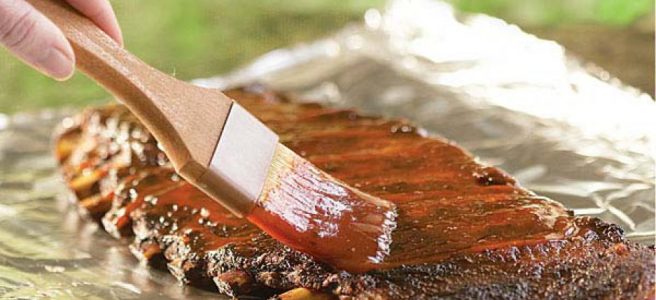
As he pulled them out he would stick what looked like a sawed-off broom handle with a mop head on one end into a 5-gallon bucket of sauce. He would then slather them with sauce, test for doneness and place them, once again, in just the right spot on the grill grate over the glowing coals. This action would be repeated for hours, he told us, adding a few more sticks of water-soaked hickory every now and then to keep the smoke roiling up, around, and through, the slabs of ribs. When they were perfectly done, he would plate them while calling for a server to deliver the meal.

While we were mesmerized by the skill of the cook, the waiter came to our table. He first asked for a drink order—sweet tea, ‘Coke’ (‘Coke’ being the generic name given to any soft drink regardless of whether or not it was a cola or orange soda), or beer. That was the extent of our options.

Upon returning with our tea, I asked him for a menu so we could order. He said “Menu? One slab or two”.

“Could I see a menu?” I said. I thought maybe he didn’t understand my request. “That’ll help me decide.”

He said, “Our menu is ribs. One slab or two? We make it easy. It’s all you have to decide.”

“What if I would like some slaw to go with that?” I asked.

“It’s in the sauce.”

“And some beans.”

“It’s in the sauce.”

“No, I want these items as side dishes.”

“Look,” he said, “we have ribs. One slab or two. Everything else is in the sauce.”

Loosening my belt and the waist button on my britches, I ordered 2 slabs, and a refill on my sweet tea.

When the order came, it was served on a paper plate with no silverware, plasticware, or hardware. Two slabs of ribs, one on top of the other, steam rising from the plate and flooding all five senses with intoxication that I was powerless to resist. These ribs were willing themselves to my watering mouth.

Just then, the waiter snapped me out of my trance by putting another paper plate on the table. He looked me straight in the eye and took the twisty tie off of a loaf of Wonder Bread. He stood the loaf of bread on the open end as he slowly pulled off the plastic sleeve, leaving a stack of bread on the plate in the middle of the table. It was the closest thing I could imagine to foodie burlesque.

“I thought you only had ribs”, was my sarcastic observation.

He replied, “you’re right.” Pointing to the stack of bread slices, he said: “These are the napkins”.

Noticing the puzzled look on my face, he grabbed an end of one of my slabs, lifting a rib to his mouth and drawing the meat off of the bone with a gentle slurp. He chewed slowly and swallowed. He then flipped the bare bone on the table, took a slice of “napkin” and wiped his messy fingers and mouth until they were clean. He popped the rolled-up napkin into his mouth, chewed a few times, then swallowed.

“We’re not big on doing dishes,” he said.

As he walked away, he glanced back at me, offering a bit of wisdom for life.

“Everything you need is in the sauce.”